Effective Collaboration in the Classroom and Online!
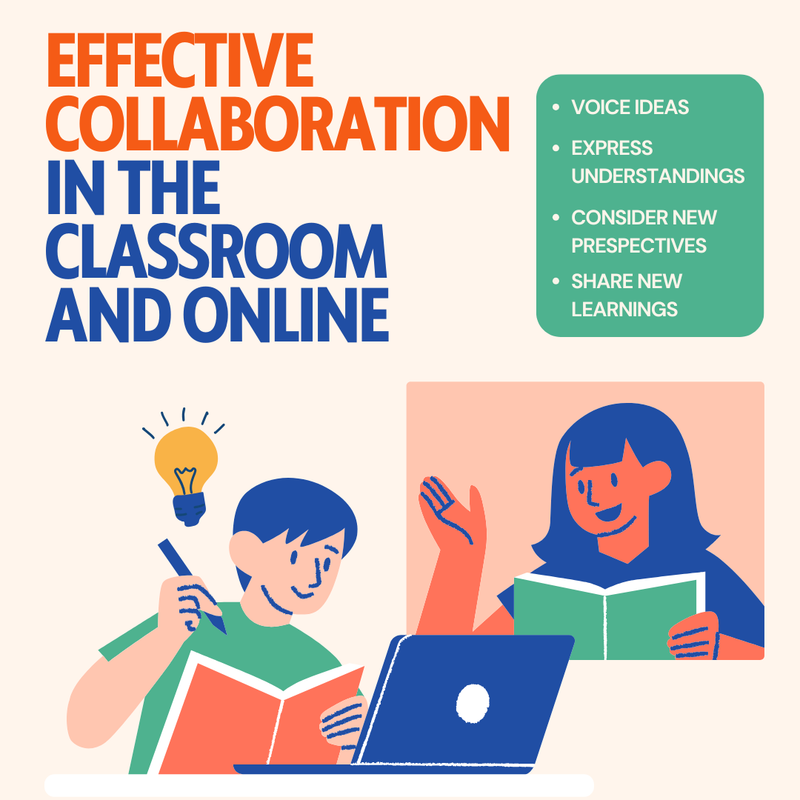
ELAL Learning Outcomes (Knowledge) - Collaborative dialogue can empower individuals or groups to voice ideas, express understandings, consider a variety of perspectives, and examine new ways of thinking. (Skills and Procedures) - Offer relevant information and logical reasoning to enhance collaborative dialogue. Consider varied perspectives or opinions when collaborating. Reflect on and share new, expanded or adjusted learnings resulting from collaborative dialogue.
This lesson provides students with the opportunity to deepen their understanding of collaboration, explore the different roles within a group, and reflect on their own role as contributors to the collaborative process, helping them become more effective team members.
Key vocabulary:
Collaboration - working together with others to share ideas and diverse skills for a common purpose.
Active listening - this skill goes beyond simply hearing the words but also actively processing and seeking to understand the meaning of the message.
Respect for diverse opinions - acknowledging that others may have different opinions from their own but acknowledge these differences by listening and showing respect for others.
Compromise - to agree to give up something you want if the other person(s), who has different opinions from yours, gives up something they want in order to resolve the situation and move forward on the project.
Conflict resolution - the skills that enable a person to quickly, respectfully, and effectively solve a conflict. Other important additional skills include assertiveness, active listening, problem-solving, empathy, and effective communication.
There may be additional terms that need to be defined.
Lesson:
This lesson is an extension of the Grade 5 lesson on Collaboration.
Objectives: Students will redefine collaboration and its additional skills. They will review the different types of collaborative styles and which style they most closely fit. They will apply their learning as a blog reflection on previous group collaborations and reflect on how they could have collaborated more effectively.
Activity - Part 1:
Key Questions:
What is collaboration?
Why is it such an essential skill, both in school and society at large?
Can it be difficult to collaborate? Why? and in what situations? (write about experiences with group work)
What skills do you need in order to collaborate well? (active listening, problem-solving, assertiveness, compromise, etc.)
Do different people within a group have different collaborative skills?
Have the students use these questions and others that arise from the discussion to share their thoughts in a blog page.
Review the 4 main collaborative styles: the contributor, the coordinator, the communicator, and the challenger.(Taqaddam, My Life Skills, https://www.britishcouncil.org/education/skills-employability/success-stories/taqaddam-programme)
The contributor - the person who contributes ideas and solutions to problems, content.
The coordinator - the person who organizes the group and the content, identifies what needs to be done, and assigns tasks.
The communicator - the person who listens and responds to the ideas and suggestions of others, who clarifies what is being said in order to keep the communication and project itself going forward.
The challenger - the person who questions and challenges the ideas being presented, looking for better and stronger ideas, for better understanding of the content, for a better end product.
Ask the students whether these roles adequately describe what they have seen in group work. What roles are missing? Which one most closely matches you? Can you identify others that match each of these styles and why?
Part 2:
Students now have the opportunity to reflect on a group work situation that didn't go well. "Keeping in mind what you understand about collaboration, about your own skills and role within a group, what could you have done differently to collaborate more effectively in this group?"
Students should include:
1) a clear definition of Collaboration in their own words;
2) an explanation of each of the roles and who assumed each of these roles in the group;
3) how you, in your role, could have contributed more effectively to support your group's work.
This analysis activity will encourage students to look more closely at their own role within a group and how they can become more effective collaborators.
Students can submit blog as part of written reflection.